Running Bib Preservation Methods Compared
Each method preserves a different part of what the race means to the runner.
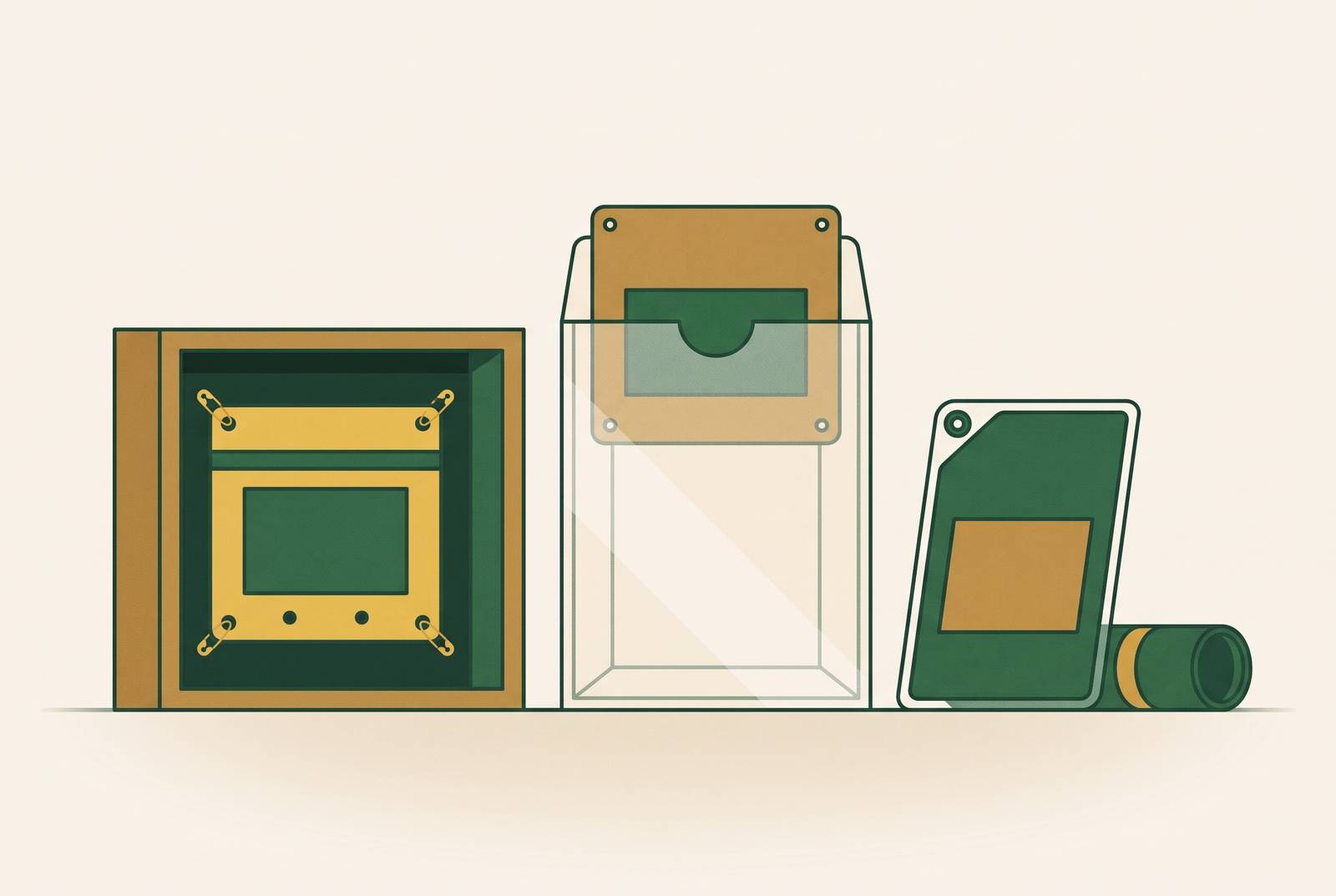
Running bib preservation methods differ in what they preserve and how they look. A shadow box protects an artifact, an album keeps a sequence, and route art or a craft derivative translates the achievement into something new. The useful comparison begins with what the runner wants to retain, because each method answers a different question about what the bib has become.
Why runners keep race bibs at all, and why the keeping is harder than it looks
A bib found in a drawer may be creased, pin-holed, and slightly damp. Those marks show how it has changed from the flat sheet the runner picked up before the race. Before the start, it was an organizer’s tool. After the finish, it is evidence of something the runner did, with the day’s physical traces still attached. RoutePrinter captures that change by describing a bib that “made it through training buildup, travel, weather, and race morning feels like proof”.
The object is also unusually suited to display. Its oversized number, high-contrast color, and minimal clutter were designed for race-day legibility, but those features remain effective behind glass. Its visual strength does not make it durable, however. First4Frames Gallery notes that standard mount boards have acids that make paper yellow and brittle within just a few years, while thermal ink is especially sensitive to light. A drawer or corkboard leaves that fragility unresolved, so keeping a bib becomes a decision about both meaning and protection.
How a shadow box works and what it commits a runner to
Shadow-box framing is the default approach because it combines physical protection with permanent visibility. The frame makes the bib part of the room and has space for other objects from the race. Depth is the first structural requirement. First4Frames explains that a deep-rebate frame accommodates a medal with a bib, whereas a standard picture frame flattens the ribbon and presses the medal against the glass.
Within that space, the runner chooses how the race will be represented. The bib can sit with its medal and a finish photo, putting the runner’s number, reward, and a picture from race day in one display. Frame Destination describes shadow boxes as combining objects, textures, and backgrounds into a unified story. The arrangement interprets the race through the prominence given to each object, even when all the original pieces are still there.
The materials then determine the display’s long-term protection. RoutePrinter specifies acid-free, lignin-free conservation-grade board, UV-filtering glazing, and reversible mounting strips. It treats materials not labeled archival or conservation-grade as unsafe for long-term display. First4Frames describes UV-protective glazing as sunscreen against the rays that fade ink and calls standard cardboard mounts “the silent killers of race memories”. Glass alone is not the whole solution.
The MedalAwardsRack 3-in-1 Shadow Box comes in black, white, or walnut, with tempered glass and wall-mount hardware included. Those features establish its finish and installation format. They do not replace the separate decisions about archival backing, UV filtering, or how the bib is secured. The runner still commits to one race occupying one wall position in a fixed arrangement.
The bib can come out of that fixed arrangement without damage. Reversibility concerns the mounting method, rather than whether the display is intended to stay on the wall. RoutePrinter says a bib should be mounted gently enough to come out later without damage and notes that most DIY installations skip this step. Adhesive mounts become permanent by default. A shadow box therefore involves two distinct commitments, namely how the race is presented now and whether the original object can safely leave that presentation later.
The scalability problem shadow boxes cannot solve
A collection changes the logic of that commitment. A shadow box may suit one meaningful race, but most homes will run out of wall space if the runner keeps framing more. Each new race needs another spot or a change to a display already on the wall.
Selecting only a few races is not necessarily an easy answer. The bib that means the most may come from a hard day rather than a personal record, while a breakthrough result may matter for quite different reasons. Wall space forces those meanings into competition. It also favors the individual event over the relationship between events. Early bibs may document participation and later ones personal records, making the collection a progression that no single-race display can contain.
The album or portfolio exists to hold that progression. Each bib remains dateable and browsable, the collection can expand, and no race has to be irreversibly assigned a position in a display. The sequence becomes the organizing principle. A less dramatic race can stay in the record because it helps show what came between other races.
A larger frame offers a partial bridge between the two formats. RoutePrinter notes that multiple mat openings can bring several bibs into one composition. That reduces the need for separate frames, but it still requires a decision about how many races the display will accommodate. The boundary remains fixed in advance. An album accepts a different compromise, offering flexibility and completeness with minimal UV protection, so a collection stored in a brightly lit space will fade. Scale changes the appropriate format, but it does not remove the need to account for physical deterioration.
When the physical bib is not the point: GPS route art as a separate category
GPS route art changes the object of preservation. Rather than treating the bib as indispensable evidence, it treats the route as the achievement and the paper as incidental to it. Drawn from Strava data or a GPX file, the display begins with geography and translates the runner’s movement into a visual form.
A giver can commission route art from the race name, date, and the runner’s GPS data or a publicly available route, without obtaining the physical bib. Access to the original object is unnecessary. The result can recognize a particular achievement in a way generic running gear does not. A public route represents the course, while the runner’s own GPS trace provides the more personal source of movement through it.
Sweat, pin holes, and fold marks establish the bib’s actual contact with the runner on race day. A digital print interprets the run. For a runner who cares most about having worn that particular bib, even an accurate route leaves out what matters most.
For another runner, the hierarchy is reversed. The course and the training data behind it may feel more personal than a bib whose number font matches every other finisher’s. The GPS trace belongs to that runner’s body moving through that course on that day. Here, translation is not necessarily a loss. Route art gives visual form to the part of the achievement the runner already considers most significant.
Craft derivatives and ornamental objects: when the data transfers but the bib does not
Craft derivatives transfer the race’s identifying information into a new object. A name, number, race, and date can survive independently of the original bib, which may return to a drawer or be discarded. The new substrate becomes the keepsake. This approach differs from both enclosing the paper and depicting the course, because its continuity rests on the identifying facts. The finished object refers to the achievement without claiming to have participated in it.
That makes this category accessible to non-running gift-givers. A giver can work from the race name, date, and runner’s name without needing the bib or a GPS file. The informational requirements are comparatively simple. The gift can still be specific to the person and event, even when the giver has no access to race-day materials.
Durability is a central part of this exchange. A laser-engraved wooden plaque avoids the bib’s yellowing, fading, and need for archival mounting by abandoning paper entirely. That solves a material problem, but not an emotional one. The plaque has none of the sweat, pin holes, or race-morning fold marks left on the worn bib. It functions as a label for the achievement.
GPS-embroidered apparel occupies a related but distinct position. It transfers the runner’s training and race-route data into stitching on something that can be worn again. Continued use replaces display as the purpose. When the training weeks appear on the shorts with the course, the object connects the preparation and the race to what comes next. Its source is closer to route art, but its destination is not a wall or archive, showing that the information preserved and the form chosen are separate decisions.
Matching the method to what the runner believes the bib actually is
If the bib’s value resides in its race-day provenance, a substitute containing the same number or route does not satisfy the same need. Shadow-box framing fits a race of singular weight that the runner wants to see every day. Its conservation materials protect the artifact while its composition places the bib, medal, and photo in relation to one another. The deciding feature is attachment to that particular object.
If the relationship between races is more important, the album offers a different fit. It treats each bib as an entry in a running autobiography. No single race needs to dominate the collection. The accepted exchange is lower archival protection for completeness and browsability.
Route art suits gifts that must work without access to the bib because it fits an attachment to the course and the data. Craft derivatives fit an attachment to the achievement’s identifying facts, while wearable versions give those facts or traces a continuing use. The original paper need not be precious. A decorative plaque and embroidered apparel can both replace the bib, with one marking the achievement as an object and the other connecting it to later running.
These categories do not require an exclusive choice. A runner might frame one defining race, keep the others in an album, and commission route art for someone who ran with them. Each choice serves a different relationship to the experience. When you consider what the bib means to you, are you trying to preserve the object, the record, the route, or the story, and which of those will still feel like enough years from now?