The Only Running Gift That Encodes the PR Course Itself Not the Time on the Clock
Embroider the actual route they ran, not just the time they achieved.
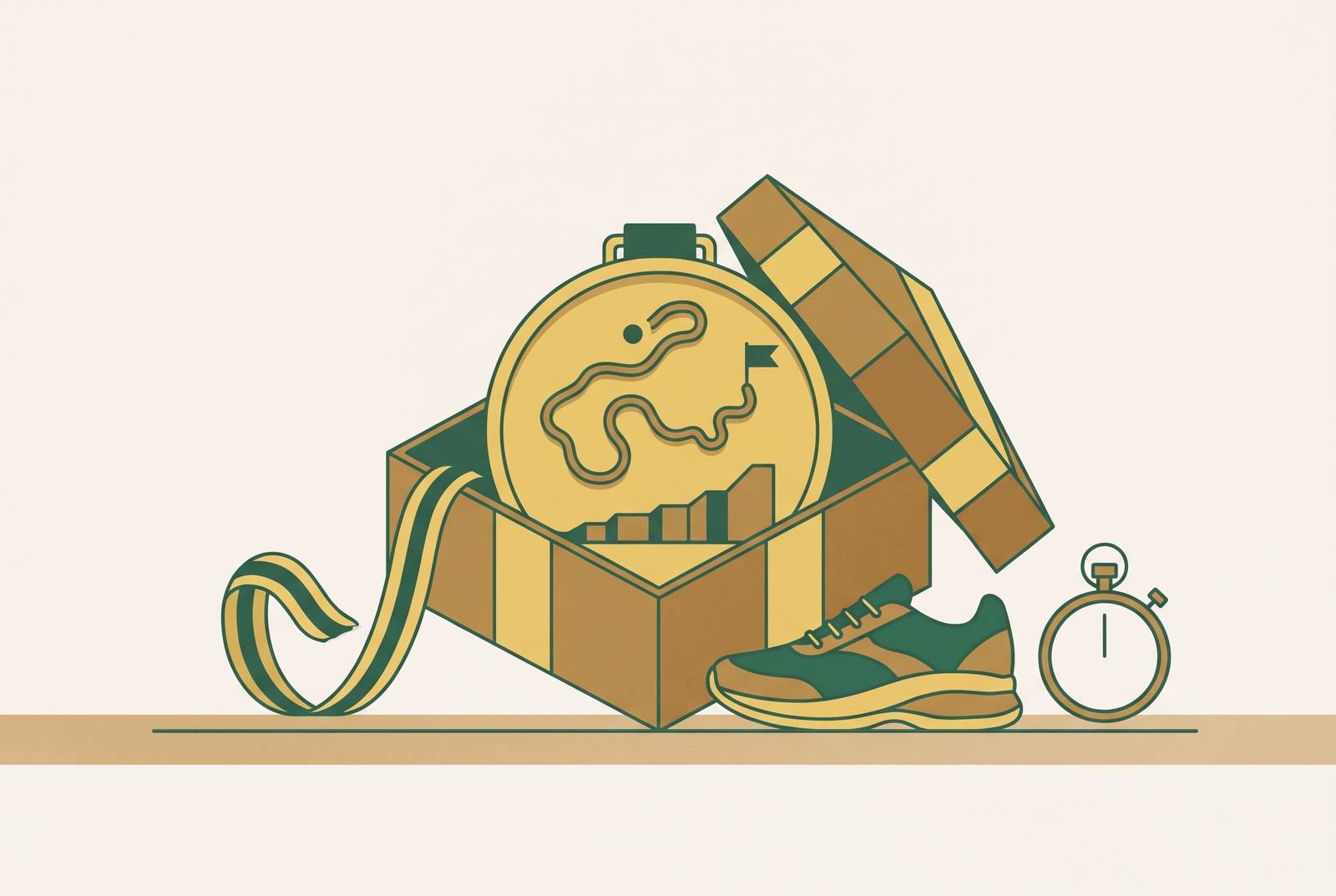
For a runner who already has every medal and gadget, the strongest gift is an embroidered rendering of their PR course, made from their own GPS data on something they will use during training. It honors the ground they covered. The finish time can remain part of the design, but the route deserves the foreground because it records an achievement that a later PR cannot replace.
Why a PR feels like more than a time
In the finish chute, the watch gives the runner a number, and then the realization arrives. The effort was enough. Months of training have become proof that the runner can do something they could not do before. That is the emotional weight of a personal record, or PR, and it explains why this finish feels different from another completed race.
Unlike a race placing, a PR removes the rest of the field from the comparison. The contest is current self against best self. Its significance comes from crossing a personal threshold. A gift for that moment therefore has a demanding task, which is to recognize both the result and the effort that made it possible.
What the training block put into the course before race day
A training block builds toward that geography through long runs, easy miles, and the gradual development of a base. For a marathon runner, that work takes up much of the week, every week, with more than a few runs here and there. The long run becomes the anchor of that routine. Its progression toward the longest effort, followed by the taper, gives the buildup a structure that points toward race day.
That structure also makes the destination familiar in advance. The runner mentally rehearses the turns, the hills, and the finish straight while preparing to meet them with a trained body. The course is not just a map supplied by an event. It becomes the place where all that preparation will be tested, which gives its outline a significance that a stranger looking at the same map cannot see.
The race-day route therefore represents more than one morning. It is the endpoint of the accumulated work, even though its line cannot display every earlier run. The training files record the work that went into the race, while the race file records where that work finally led. The GPS file is the clearest record of what actually happened on the day, and the destination toward which all those earlier files were pointing.
How a GPS file turns a run into a shape that can be held
A runner’s watch creates a GPX or FIT file that records the course they followed. Turns, climbs, and straights become data that can supply the outline of a physical object. The raw material already belongs to the runner. Strava, Garmin Connect, and similar platforms offer GPX export as a standard way to record runs, so a personalized course gift can use what the runner already has.
RoutePrinter’s 2026 guide describes the GPS file as “the most accurate record of what really happened. Not the marketing version of the course. Your version.” That distinction separates an official course image from the record of a particular effort. Both may depict the same event, but the runner’s file connects the object to their own passage through it.
Once rendered as a line, the route also has a visual character. A city marathon looks like a clean, graphic shape, while a trail race has a rougher outline that follows the land. The geography gives each design its form. RoutePrinter describes GPS route art as a link between how someone ran and what they remember, keeping the route in a form they can frame, give, or hang where they train. What began as a record on a watch can become a shape that is held.
What the course-first gift market actually looks like right now
Mark Your Moment makes route prints from a public Strava activity link or an uploaded GPX file. Its range also includes classic route prints, photo and route upload designs, medal display, elevation prints, urban prints, and multi-day route formats. These are different ways to give a completed effort a visible form. The choice is not simply whether to display a route, but which part of the experience the surrounding design brings forward.
A photo and route design places an image with the geography, while an elevation print gives prominence to the course’s vertical profile. A medal display gives the race award a place in the commemoration. Multi-day route formats can show a journey that takes more than one outing. Each format has a distinct emphasis without needing to compete on the same terms, and each offers a different answer to what the recipient may want to remember.
The route is already an established subject for a commemorative object. A gift can include the complete route and still make the finish time its headline detail, leaving the geography to serve as the background for the number.
Why the course shape carries meaning the finish time cannot
The distinction is between what happened and how that performance ranks afterward. A PR time can be superseded when the runner next races faster. The course they ran that day stays part of that effort. Its commemorative meaning does not depend on the performance retaining its status as the runner’s best, which makes geography a more durable foundation for the gift.
That permanence belongs to the completed event. The runner moved through a particular place on a particular day, and no later result can revise that act. A time-first gift may eventually celebrate a former record.
The route also holds the effort together when the result is less straightforward. Whether a runner meets a goal or misses it by two minutes, the course is the ground every finisher ran through. The clock can distinguish their performances, but it cannot describe the experience by itself. The hill at mile eighteen, the exposed stretch into the headwind, and the final turn when the finish line appeared belong to the runner’s memory of place.
A course-first design gives those memories a shape to hold on to. It draws the viewer to where the effort happened and what the runner moved through, so speed is only one way into the story. That does not diminish the achievement of running faster.
The strongest objection is also the most reasonable. Runners train for times, and leaving out the clock can seem to leave out what they worked for. The finish time can appear as secondary text while the route occupies the foreground, preserving the result without asking it to bear the whole meaning of the gift.
Why embroidery in particular matches the logic of training
Embroidery gives the route a form that echoes how fitness was built. It accumulates stitch by stitch, just as a training block accumulates through repeated runs.
Thread also makes the work of production visible. A digital download is instant, and a printed poster can be generated in seconds from a file. An embroidered piece requires time to make the line in thread. That difference gives embroidery an additional expressive quality, because the object shows evidence of labor alongside its result.
Making an embroidered route does not reproduce the runner’s physical commitment or measure up against the training block. The route records where the effort happened, while the stitches offer a visible counterpart to the patient accumulation that made the effort possible.
What it means for a gift to be made from the runner's own GPS data, on a thing they will actually use
A wall piece gives the race a fixed place to be remembered, while a usable training item takes the memory into the next long run. The distinction is practical as well as symbolic.
Personalization also becomes more substantial when the design begins with the runner’s own file. The route is selected from the recipient’s recorded effort and made for that person, which makes the gift specific in a way that another general piece of equipment cannot be. The made-to-order logic resembles the training plan in this respect, because both are organized around a particular runner and a particular day.
Training data on the hem can extend that specificity beyond the race itself. Weeks, miles, and runs describe the preparation. They give the buildup a place on the object. Where the course line records the destination, those details acknowledge the repeated work that led there, which most commemorative objects leave out.
For a runner who already has the medals and gear, this is the strongest distinction. The gift gives an existing achievement a new physical form, with the personal route as its source and training use as its purpose.
How to get the GPS data and what to give a runner who already finished
For the gift-giver, the first practical step is to obtain the runner’s GPS file. The simplest approach is to ask for it. Most runners are happy to share a Strava link or export a GPX file from their platform, and asking directly avoids turning an accessible record into an unnecessary obstacle. The request can focus on the race being commemorated, since that is the activity the design needs to represent.
RoutePrinter notes that GPX or FIT files can be exported from Strava, Garmin Connect, COROS, Polar, and Suunto. The runner therefore usually has access to the source material through a platform they already use. The files that can be used depend on the gift format or the provider. Mark Your Moment, for example, accepts a public Strava activity link or a GPX upload for its route prints, so those options should not be treated as interchangeable requirements for every kind of gift.
Immediately after a PR race is a natural time to begin. The course is still vivid, and the runner is still absorbing the realization that they have done something new. A made-to-order gift can also arrive weeks later, after the data has been submitted and the proof approved, when the race is becoming a memory and attention is turning toward the next goal.
For someone shopping after the finish, the delay can be part of the gift’s fit. The object arrives as a lasting form for the experience, celebrating the achievement after the race-day excitement has passed. The course is already there, waiting in a file, and the gift is the decision to make it real.