The Intimate Details Only a Partner Knows That Should Shape a First Marathon Gift
A partner's knowledge of the race is what makes the gift personal.

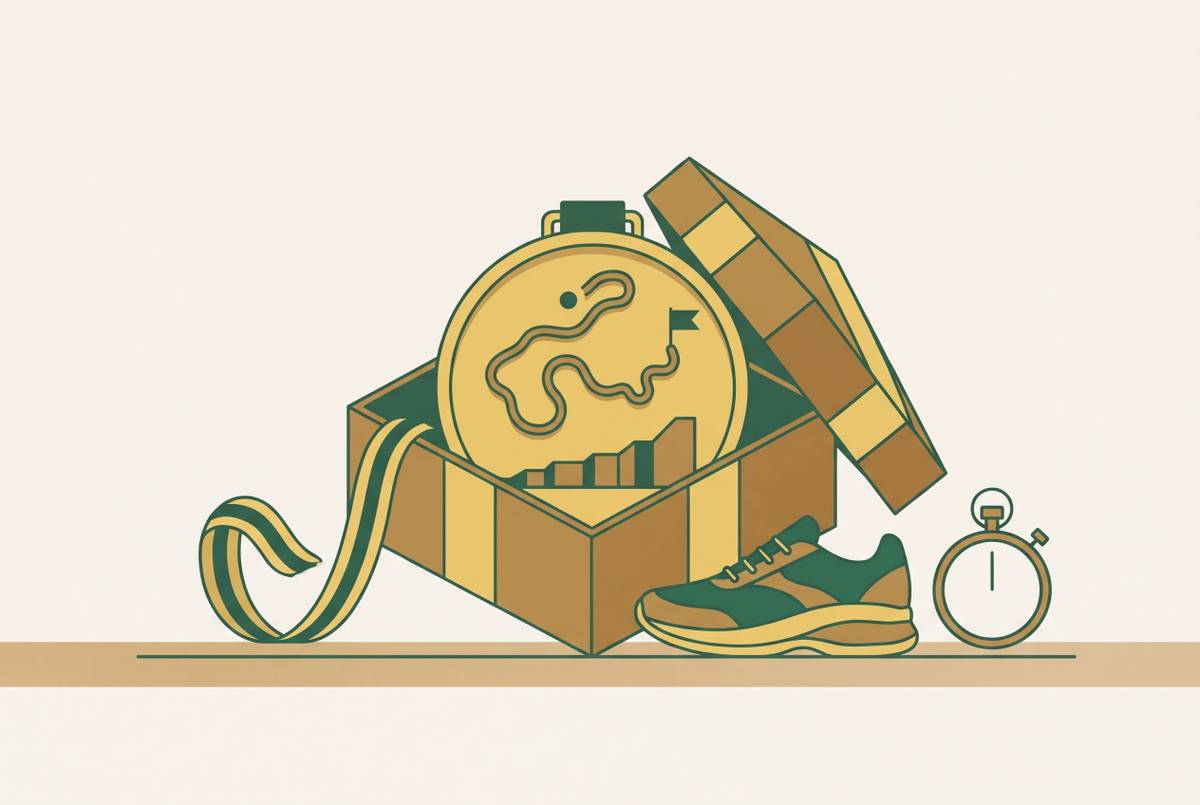
The most meaningful gift for someone who just ran their first marathon is a record of their particular race, shaped by details only someone close to them would know. A custom GPS route print is a good first choice, while embroidered running gear or a medal-and-bib display may better fit other habits. For a partner, the decisive addition is a written memory of the moment they witnessed.
Why the first marathon is unlike any race that follows it
A first marathon changes the terms in which a runner can describe themselves. Before it, completing the distance is a possibility. After it, being a marathoner is a fact. Jeff Brown, the lead psychologist for the Boston Marathon medical team, frames the marathon as an objective measure of self-concept, a way people come to terms with themselves and their capabilities. The finish therefore marks more than the end of a race.
That change takes months of preparation, hundreds of hours of training, and changes to daily life for the runner and those around them. A partner has lived through that preparation, even if they have not run the miles. Later marathons may bring new goals, but only the first takes a runner from hoping they can finish the distance to knowing they can. The first marathon’s unrepeatable character should govern the gift, which needs to preserve this achievement.
What a partner witnesses that no one else does
Marathon training plans usually last 16 to 20 weeks, and beginners are advised to allow 18 to 20 weeks. That gives a partner time to see the work through base building, two build phases that get harder as they go, and the taper. Each phase has a different texture. Reduced mileage during the taper can bring anxiety and irritability, the “taper crazies,” just when the physical workload is easing. A partner knows both what the training schedule called for and how it felt to live through it.
NYU psychologist Emily Balcetis’s research shows that runners reach finish lines through focused visual attention, looking at one target ahead and then another. This finding concerns runners’ attention in general. It nevertheless points away from treating endurance as one uninterrupted act of inspiration. The specific targets deserve attention.
A partner already knows which parts of the preparation meant the most to the runner. There was the long run that changed the runner’s confidence, the week mileage peaked, or the familiar route they returned from looking different. Race day gave them more memories to add to those. A gift guide can suggest objects, but it cannot supply the history that distinguishes one runner’s first marathon from another’s.
Why generic gifts fail the moment the partner already has
Practical gifts have a legitimate claim on the days after a marathon. Foam rollers, massage guns, and compression socks address a sore, depleted runner’s immediate needs. A Theragun may be more welcome than wall art while recovery is still the priority. That preference is reasonable and compatible with an interest in remembering the race. Recovery and commemoration serve different purposes.
The distinction is between usefulness and specificity. A foam roller can support recovery without saying anything about the course, the goal, or the finish. A gift built around the GPS route, race date, bib number, and finish time identifies the achievement itself. The practical object may remain useful, but its connection to this first marathon is not built into its form.
For a partner choosing a commemorative gift, that difference is decisive. The runner recovers, but the race stays part of their life story. The task is to choose an object that can remain associated with this achievement after the immediate physical need served by compression socks has passed. The raw material for that choice is already in the partner’s possession.
The four details a partner holds that should drive every gift decision
The route is the first detail. The GPS track records where the runner’s body traveled, including the specific turns, elevation changes, and miles of the race. It is not a generic marathon silhouette. Garmin, Runkeeper, and Apple Watch through third-party apps offer ways to export activity data in formats including GPX, TCX, or FIT. Where an activity is visible and export is available, a partner can obtain the route without asking the runner to reconstruct it.
The race particulars are the second detail. The race name, finish time, date, and location locate the achievement precisely. They also distinguish a commemorative object from running-themed decoration. A partner knows the goal that drove the training block and can understand the finish time in that context. The number gives the result, and knowing the goal helps explain what that result meant.
The bib number is the third detail. The physical bib bears the marks of the day, including sweat and rain, as well as the number that identified the runner on the course. For many runners, it is as important as the medal. A partner who kept it, photographed it, or noted the number has preserved something other gift-givers may overlook. The number can become part of an inscription even when the bib itself is displayed separately.
The witnessed moment is the fourth detail. It may be the expression at mile 20, the instant the runner found their partner in the crowd, or what was said at the finish. A finisher’s photograph cannot show every such exchange. This detail belongs in a card, a note, or an inscription. Joined to an object that records the race, it becomes testimony from someone who was there.
How the GPS route becomes a physical object the runner keeps
Custom route art takes activity data from a fitness app and makes it into an object. The formats range from framed wall prints to three-dimensional objects, but their defining feature is the same. They depict the runner’s actual course. A minimalist route print can therefore be visually spare without being impersonal, because the line itself contains the specific geography of the achievement.
MyAdventureMaps offers custom route posters with the official race name, finish time, date, and a stylized 3D perspective of the actual elevation profile. The route shows where the runner went, and the elevation profile shows the course’s rises and falls. The accompanying particulars identify when and how the race was completed, making the poster a physical record.
To create that record, the partner needs to locate the race activity in Garmin, Strava, or a similar app, export the GPX file where available, and upload it to the chosen service. The process does not require technical expertise. MyAdventureMaps allows gifts to be built for someone else without their password when the activity is visible and its GPX file can be exported. The runner can then hold the route, hang it, and look at it again without opening an activity feed.
What embroidery adds that a print cannot
Embroidered commemorative apparel gives the same race record a different function. A framed print belongs on the wall. Running gear goes back into use, allowing the achievement to remain present during the training that follows. The choice between the two is therefore not simply a choice of appearance. It depends on whether the runner is more likely to value a record they display or one they wear.
Embroidery also distinguishes itself from printed apparel through its construction. Stitched words and pictures hold up when washed again and again, while printed designs can fade and peel. The details are worked into the garment in thread. Made-to-order production supports that specificity, with each piece produced after the order is placed and made to the details the buyer provides. Its commemorative value comes from those details.
Shorts have a particularly direct connection to future running. They can go on the next long run, into the next training block, and to the next race. A design with the course on the left leg and training data on the right hem makes the garment a wearable record of the work already completed. That serves a different habit from keeping a print in view. Wearing the first race into preparation for another is its own form of commemoration.
Keeping the physical artifacts of the race from disappearing
The objects from the race need a home too. Without one, the medal can end up in a drawer, the bib can crumple in a box, and finisher’s photographs can disappear from view. Hook-style medal displays work well for a single race, while steel multi-rack displays have room for more medals as the collection grows. The first marathon medal can become the anchor for what follows.
The bib deserves equally deliberate preservation. BibFOLIO accessories allow race numbers to be kept with photographs and details including the date, location, finish time, and reflections. This keeps the original artifact attached to its context. A running journal given in the days after the race serves a related purpose, providing a place for the recap while memories are fresh.
The medal marks completion, the bib retains the physical traces of the day, and the journal holds the recollection. A partner choosing a display is making a practical provision for memory. It is a daily choice to remember, made once by someone who was there.
How to combine what you know into one gift that could only come from you
A partner should begin with how the runner will live with the gift. Does this runner look back or run forward? Someone who wants the race on the wall calls for route art or an artifact display. Someone already thinking about the next training block may want something they can wear.
The available details then give that form its identity. Exporting the GPX file provides the foundation for a route print or an embroidered course, while the race name, date, finish time, and bib number supply the inscription. The witnessed moment belongs in the card, the note inside the box, or an inscription on the back. That division lets the object record the achievement and the words explain the partner’s place in it.
For example, embroidered shorts paired with a card naming the mile where the runner looked up and found their partner in the crowd have two distinct functions. The shorts keep the course on something the runner can wear. The card preserves the exchange. One specific object and one precise memory can do the work.
The week after the race is the right window for that gesture, while the runner is still living inside the experience. A month later, the training cycle has receded and the same gift arrives in a different context. Giving it promptly recognizes both the finish and the weeks that made it possible. The partner’s advantage is having watched the preparation unfold, understood what the runner was trying to do, and remembered the moment when that effort became an achievement.