Ritual and Ceremony Around Race Day in Running Culture
Months of private habit, not the race itself, give a marathon its meaning.

Race day in running culture is not a single event but the visible peak of months of private ritual. Training, pre-race routines, the shared start and the ceremony of finishing form one continuous act of meaning-making. The race gives that process a public shape, but its lasting value comes from the practice, identity and relationships built around it.
Why runners build rituals around racing in the first place
The question of why people run marathons has a more interesting answer than fitness alone. For a first-time runner, the goal can be proof of personal capacity, rooted in self-esteem and the desire to achieve something difficult. For a repeat runner, the race affirms the place running already has in daily life and in who they are. Running becomes not merely an activity but a way of understanding who that person is. Finishing thus means more to the runner than physical performance alone can explain.
That personal significance also has a social dimension. Marathon participation makes perseverance visible and connects the runner with a group whose qualities they value. In a fragmented world, the race offers a clear goal, a shared identity and an achievement that other people can readily understand. Its common measure is part of its force, with the same 42.195 kilometers confronting elite athletes and people running through grief or celebrating recovery. Their lives and finishing times differ, but the distance brings their separate stories into the same ceremony.
How training months become a private ritual before the race even exists
That frame begins to take shape when training starts, long before the runner reaches a race venue. Early alarms, weekend long runs and meals arranged around running restructure the calendar as the body changes. These acts can look mundane in isolation, yet repetition gives them a place in a larger personal story. Behavioral scientist Michael Norton describes rituals as turning everyday habits into acts that mean something to the people who do them. In marathon training, that distinction explains how a schedule can become a means of reconnecting with the body and rebuilding a sense of self.
A first kilometer can matter as much to one runner as a sub-3-hour finish matters to another, because each marks a change within that person's own arc. Run clubs and shared plans build relationships on the roads, so part of the community that will celebrate the finish already exists months beforehand. The runner approaches race day with both accumulated fitness and a place among other people.
Training records make that accumulation tangible. GPS tracks and weekly mileage keep a record of the work that made the runner fit for the race. The long runs belong to the meaning of the race. Without them, the finish would record a distance covered but leave out the practice that made covering it possible.
The pre-race night and morning as a ceremony with its own precise choreography
As race day approaches, the identity built through training takes the form of unusually precise acts. Pinning a bib becomes more than attaching paper to a shirt. The runner smooths it, adjusts the symmetry and checks it again, with better sleep sometimes resting on the completion of this small task. The flat lay extends that order across shoes, socks, watch, nutrition and anti-chafe stick. It resembles a gear advertisement, but its role is closer to an altar, with every object accounted for before the event begins.
Breakfast follows the same pattern of deliberate repetition. The same oats, banana, mug and brand can remain fixed from the race when the combination first felt right. The continuity itself becomes protective, whether or not every detail has a practical bearing on performance. Lucky socks or underwear also hold the feelings that runners bring from past races. The object gives the runner confidence because it is familiar, so its value to the mind differs from its use as clothing.
The approach to the venue gives this private ceremony a public choreography. MK Marathon Weekend advises spending no more than an hour at the expo, collecting the bib efficiently, reviewing course information and resisting the temptation to walk every stall. That guidance treats the expo as a threshold. Getting there before the gun, warming up away from the corral and joining the right pace group then help the runner focus on the race ahead. Even the convention of leaving the race shirt unworn, with its tags on until the finish, preserves a sequence in which the right to wear it must first be earned.
The start line as a collective threshold moment
At the start line, separate preparations converge. Runners from different backgrounds and ability levels stand together with months of effort behind them and the same distance ahead. The quiet breath before the signal marks the step from getting ready for the race to running it. The countdown and surge forward give that transition a shared physical form.
The scale of an event can make this moment civic as well as personal. Yet its ceremonial force comes from more than the size of the field. Each runner brings their own past to a public event where they all share a start.
What happens mid-race when the ritual meets the body's limits
Once the start recedes, the ritual meets its hardest test. The middle miles ask whether the physical stamina and mental habits built in training can hold when the body wants to stop. Changes in pace, positive self-talk and mini-goals help runners keep going when it gets hard. These are not separate from the months of preparation but expressions of it under pressure. The race makes the runner use what repetition has built.
Aid stations and spectators help for a while, but the runner has to do that work within themselves. Self-Determination Theory provides a useful frame through its three needs, which are competence, relatedness and autonomy. In marathon running, these appear as the desire for a performance breakthrough, a sense of belonging to the running community and an environment that supports the runner's identity. In the hard miles, runners feel those needs as they reach the limits of what their bodies can do.
Unusual settings make it especially clear how the sights around a runner differ from the effort within. The Inca Trail Marathon in Peru finishes near Machu Picchu at altitudes near 4,500m, while the Antarctic Ice Marathon takes runners to Union Glacier through extensive logistics and charter flights from Punta Arenas, Chile. The runner still has to cover the distance in each place, under the conditions there.
The finish line as the ritual's formal ceremony
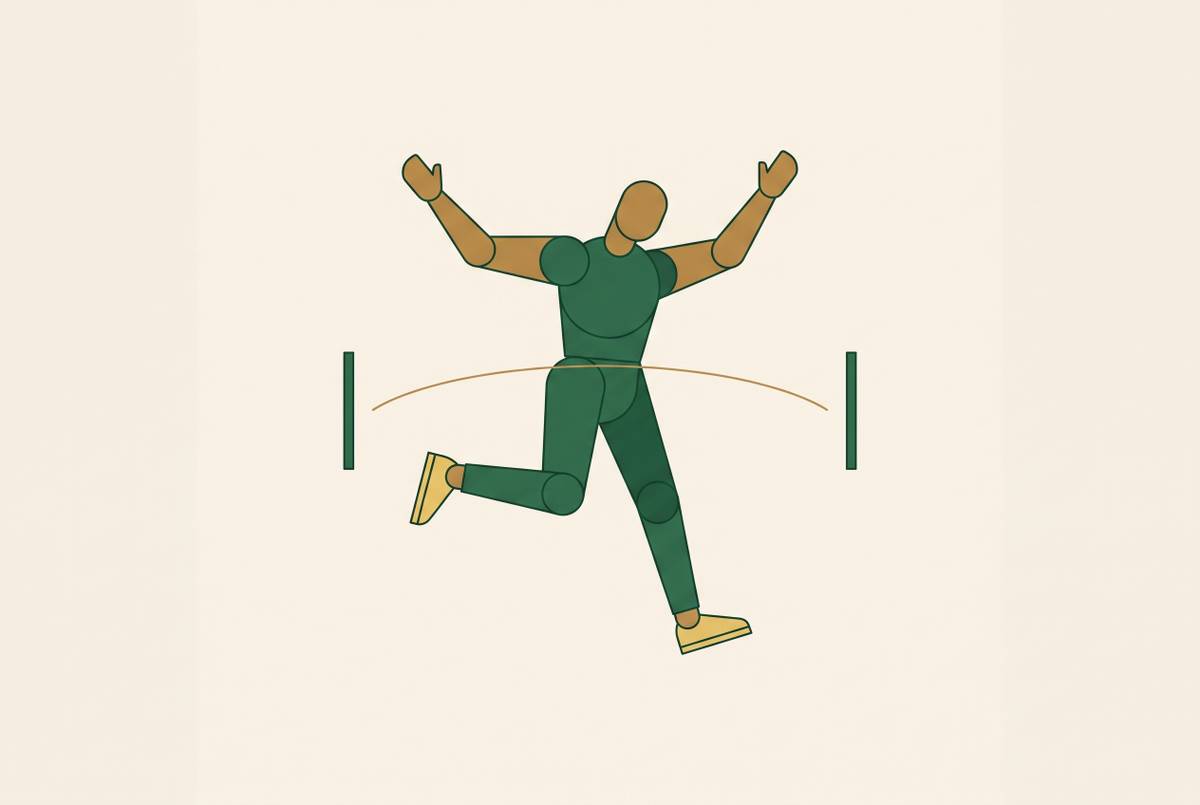
The finish line gives that effort a definite boundary. Joy, relief and fatigue arrive together, carrying the weight of training and the difficulty of the race itself. What had been spread across months of ordinary days becomes legible in a single crossing. The moment matters because it closes a task that has occupied both the body and the calendar. Exhaustion does not diminish the ceremony but helps explain its emotional force.
Races give this transition formal recognition. The Comrades Marathon in South Africa awards medals according to finishing position and time, while runners who complete the race ten or more times earn a Green Number recognizing outstanding commitment. Those who achieve a personal best may ring the dedicated PB Bell at the finish. These distinctions acknowledge that achievement has more than one shape.
A sprint or a pose for the finish camera can give way to lying on the ground with legs against a wall. The medal then serves as physical proof of an arc that no spectator can fully see. Wearing it through an airport extends the recognition beyond the course, allowing the finish to remain present after the running has stopped. The ceremony accommodates both public pride and the simple fact of a body that has had enough.
Some events make celebration an explicit continuation of the race. The inaugural Run and Fest in eastern France, May 23–24, 2026, combined marathon racing with electronic music in a festival format. Here, the finish marked a transition into celebration rather than the end of the gathering. That wider format makes visible something already present in the conventional finish ceremony, which is the need to acknowledge what has just been completed.
How runners try to hold onto what the finish line meant
A finish-line photo, medal selfie or Strava upload turns the experience into a record that can be revisited and shared. The image may pass through Instagram, the group chat and onto the fridge, where different people see it, though the achievement it marks stays the same. This is a way of preserving an experience whose intensity cannot remain unchanged.
Platforms including run2wear, RoutePrinter and MyAdventureMaps turn route files into artwork on keepsakes, making the path actually taken the artifact. MyAdventureMaps frames its custom route poster as a trophy, combining the official race name, finish time and date with a stylized 3D perspective of the actual elevation profile. Personal activity can come from Strava or a GPX/TCX/FIT file exported from Garmin Connect or other platforms.
GPS art adds deliberate expression to that record. A runner follows a route shaped like a recognizable image and then shares or frames the trace. CityHeart offers heart-shaped GPS routes city by city, including Philadelphia's Kelly Drive and Atlanta's BeltLine. In this form, the route is both the work performed and the image preserved.
Embroidery provides a different kind of permanence. Made-to-order crewneck sweatshirts on Etsy use running icons such as a bib, shoe and Garmin watch to mark the achievement in a garment. Framed embroidery of the Chicago Marathon route can also include city details such as a sailboat, Ferris wheel, train, buildings and a hot dog, preserving place as well as performance. A keepsake pairing the race route with the training weeks and miles takes that logic further. It holds the full arc together, rather than allowing the finish alone to stand for everything that preceded it.
Why the ritual repeats — and what that says about what running actually gives people
The desire for another race can appear almost as soon as the current one ends. Finish-line euphoria helps explain that impulse, but it does not fully explain repeated participation. The event was demanding, yet the months organized around it also offered purpose, connection and a clear direction. Signing up again restores an occasion for that practice.
For many runners, an event on the calendar is therefore a primary source of motivation. The medal preserves a completed achievement, while the next entry gives daily effort a future shape. Running culture helps runners keep going through groups, ceremonies and objects that link the work they do on their own to milestones others can recognize. Its rituals give the difficulty of running a place within a life.
The most substantial part of that life remains outside the public ceremony. There is no separate medal for the 5 a.m. runs, the long Sunday miles or the weeks spent getting ready. The finish is a moment of recognition. What the runner carries forward is also what nobody else saw.